
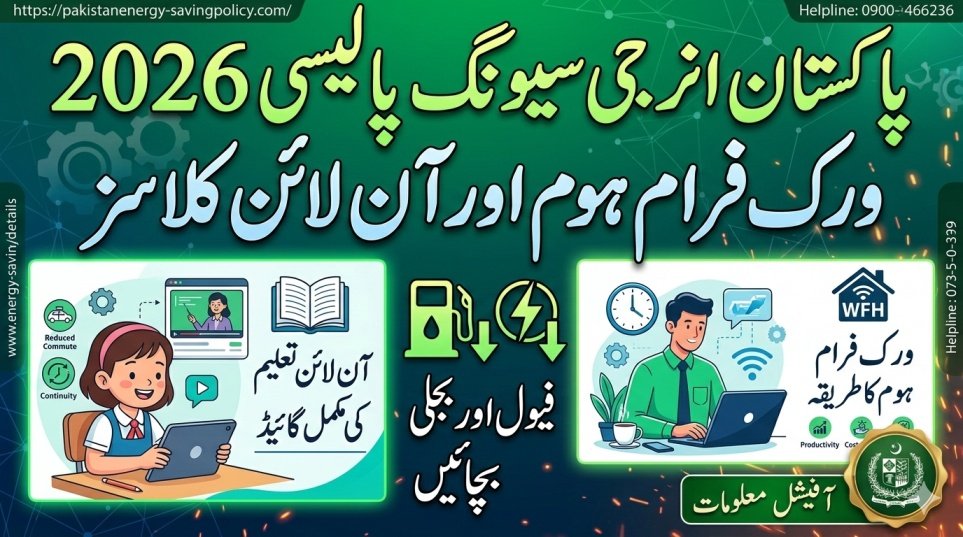
Today Update: Pakistan Energy-Saving Policy 2026: Online Education and Work From Home Guide
The Government of Pakistan has introduced a comprehensive Energy-Saving Action Plan 2026 aimed at reducing fuel consumption, electricity use, and operational costs across the country. Under this plan, schools, colleges, universities, and government offices will shift temporarily to online education and work from home policies. The initiative addresses the rising energy crisis, global oil supply disruptions, and economic pressures while ensuring continuity in learning and government operations.
| Feature | Details |
|---|---|
| Policy Name | National Energy-Saving Action Plan 2026 |
| Target Sectors | Schools, colleges, universities, government offices |
| Implementation Mode | Online education, remote work |
| Decision Authority | Prime Minister Shahbaz Sharif |
| Monitoring Committee | Economic Coordination Committee (ECC) |
| Key Objective | Reduce energy consumption and costs |
| Additional Measures | Carpooling, optimized office hours |
| Status | Draft submitted, awaiting cabinet approval |
Purpose of Online Education and Remote Work
The main goal of the policy is to minimize energy usage while maintaining productivity. Adopting online learning and remote work ensures that:
- Students can continue education without disruptions.
- Government employees can fulfill responsibilities without office attendance.
Key Features of the Draft Action Plan
The plan proposes:
- Temporary closure of all educational institutions with online classes implemented immediately.
- Reintroduction of work from home policies for eligible government and private employees.
- Promotion of carpooling and reduced office hours to further conserve energy.
These measures are modeled after COVID-19 practices, which proved effective in maintaining productivity while saving energy.
Required Documents for Policy Implementation
Institutions and employees must ensure proper documentation:
- Valid CNIC for employees requesting work from home.
- School/college registration details for online learning access.
- Proof of internet access for staff and students.
- Parental consent for students under 18 years participating in online learning.
Proper documentation helps fast-track approval and ensures a smooth transition.
Eligibility Criteria
The policy applies to:
- All public and private educational institutions capable of online teaching.
- Government offices where tasks can be performed remotely.
- Private sector employees authorized by employers to work from home.
This ensures maximum energy savings while maintaining efficiency and productivity.
Informative Table: Energy-Saving Benefits and Implementation Strategy
| Benefit / Strategy | Details |
|---|---|
| Energy Conservation | Reduces fuel and electricity usage across sectors |
| Education Continuity | Enables students to continue classes online without disruption |
| Productivity | Employees maintain work output remotely |
| Safety & Health | Reduces pollution and traffic congestion |
| Digital Skill Development | Promotes online learning and remote work capabilities |
| Cost Reduction | Lowers operational costs for institutions and offices |
| Accessibility | Remote work allows participation from any location |
| Monitoring | Supervisors can track online activity and productivity |
Benefits of Online Education and Work From Home
- Energy Efficiency – Reduces electricity bills and fuel costs.
- Safety & Health – Minimizes traffic, reduces pollution exposure.
- Continuity – Ensures work and education continue without interruption.
- Digital Skill Enhancement – Improves online literacy for students and employees.
Latest Update 2026
The draft plan has been submitted to Prime Minister Shahbaz Sharif for approval. Once finalized:
- Schools, colleges, and universities will shift temporarily to online learning.
- Government offices will implement remote work policies.
- Citizens, students, and employees should prepare for immediate transition after official notification.
How to Apply for Work From Home and Online Education
Applying is simple:
- Students and Institutions – Register on official online learning portals provided by provincial boards or universities.
- Government Employees – Submit a request through your department portal for work from home approval.
- Private Sector Employees – Follow employer guidelines to ensure eligibility for remote work.
Official updates are available on the Government of Pakistan website: https://www.pakistan.gov.pk
Helpline and Contact Information
Dedicated helpline and support services are available to assist citizens:
- Education Helpline – Provides guidance on online class registration, technical support, and access to digital learning platforms.
- Work From Home Support – Government employees can contact department portals for approval, troubleshooting, and productivity management.
- Provincial Education Boards – Help institutions implement online teaching systems.
- Digital Learning Centers – Offer staff training for managing virtual classrooms effectively.
These support channels ensure a smooth and efficient transition to online and remote operations.
Conclusion
The National Energy-Saving Action Plan 2026 is a strategic initiative addressing energy shortages and economic pressures in Pakistan. By implementing online education and work from home policies, the government ensures continuous learning and productivity, reduces energy consumption, and strengthens digital skills nationwide. Citizens are advised to follow updates via the official Government of Pakistan portal for smooth adaptation.
FAQs:
When will online classes and remote work start?
Implementation will begin after cabinet approval, with official dates announced by the Economic Coordination Committee (ECC).
Who is eligible for remote work and online learning?
All schools, colleges, universities, and government offices eligible for work from home arrangements are included.
How does this policy reduce energy consumption?
By reducing commuting and office operations, the plan lowers fuel and electricity usage, promoting national energy conservation.